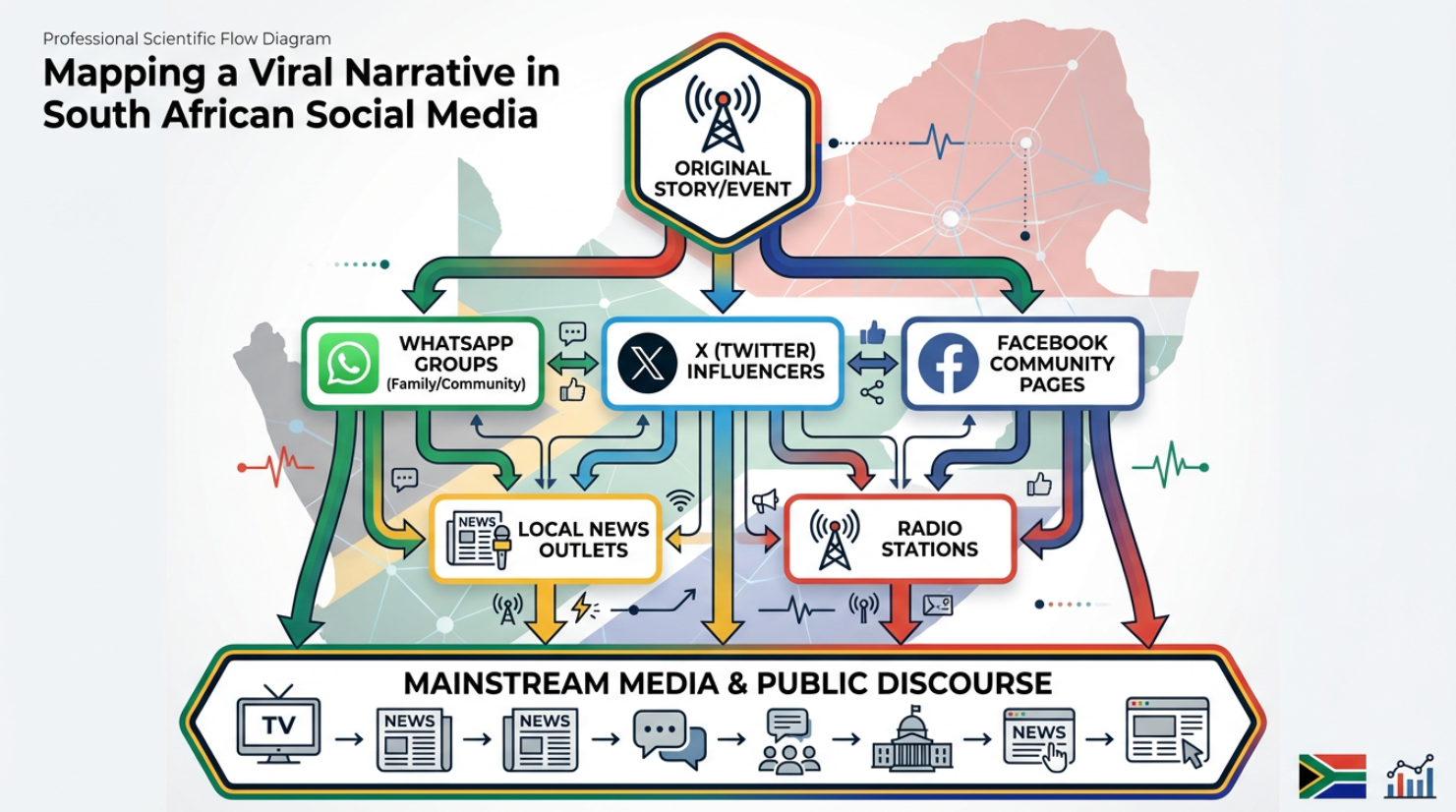

Mapping Viral Narratives in South African Social Media
In South Africa’s digital environment, a single post can shape public conversation within hours. A screenshot, voice note, or short video can move rapidly across platforms, reaching thousands or even millions of people before the full context of the story is understood.
With high mobile connectivity and strong social media engagement, South Africa has developed a complex online information ecosystem where narratives often spread quickly and evolve as they move across platforms.
Understanding how these narratives travel has become increasingly important for journalists, researchers, and digital literacy initiatives. Rather than focusing solely on individual posts, analysts now examine how information flows through networks of communities, influencers, and media platforms. Mapping these flows helps reveal how online conversations develop, and why certain stories gain national attention.
The Spark: Where Narratives Begin
Many viral narratives begin in private messaging spaces, particularly WhatsApp groups.
Because messaging apps are widely used for everyday communication, they often become informal channels for sharing news, videos, and commentary about local events.
A viral narrative might start with:
-
a video of a local protest
-
a voice note describing a crime incident
-
a screenshot of a social media post
-
a rumour circulating within a community group
At this stage, the information is usually shared within trusted networks such as family groups or neighbourhood chats. This creates what researchers sometimes describe as “high trust circulation”, where messages are forwarded because they come from familiar contacts.
However, the information shared in these spaces is often difficult to verify..
Amplification: When Narratives Move Into Public Platforms
Once a story moves from private messaging spaces into public platforms such as X (formerly Twitter), Facebook, or TikTok, it can begin to spread more widely.
Public platforms introduce new dynamics, including:
-
rapid resharing
-
commentary and debate
-
amplification by high-profile accounts
Posts shared by individuals with large followings — including public figures, influencers, or political commentators — can significantly increase the visibility of a story.
In some cases, fact-checking organisations have observed that misleading or manipulated content can spread widely before corrections reach the same audiences.
For example, during recent election periods, fact-checking organisations documented instances where edited videos or misleading claims circulated widely online before being debunked..
Echo Chambers and Algorithmic Amplification
Online discussions often develop within political or ideological communities.
On platforms like X, South African political debate frequently takes place within highly engaged online groups that share similar viewpoints.
These communities can amplify certain narratives through repeated posting, hashtags, and coordinated discussion.
Researchers studying online discourse sometimes describe this as echo-chamber dynamics, where users primarily interact with others who share similar perspectives.
Algorithms designed to promote engaging content can further amplify emotionally charged posts, which means that controversial or polarising narratives often travel further than neutral information.
From Social Media to Mainstream Conversation
A viral narrative often reaches its widest audience when it moves beyond social media and into traditional media discussions.
In South Africa, talk radio and community radio frequently discuss trending online topics as part of listener engagement.
When social media debates become topics on radio programmes or news discussions, the story can reach audiences who are not active on social media platforms.
This creates what researchers sometimes call a “legitimacy loop”, where a story that began online becomes part of mainstream public conversation.
The Life Cycle of a Viral Narrative
Many viral stories in South Africa follow a similar pattern of spread:
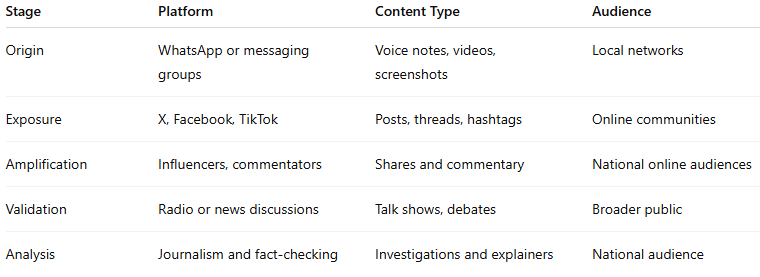
Understanding this lifecycle helps explain why some stories spread so rapidly..
The Role of Fact-Checking
South Africa has a growing network of organisations working to identify and respond to misinformation.
Groups such as Moxii Africa, formerly Media Monitoring Africa, and platforms like Real411 monitor online information flows and provide mechanisms for reporting potentially harmful or misleading content.
Fact-checking organisations also collaborate with journalists and researchers to verify viral claims and provide context where needed.
However, the speed at which information travels online often means that misleading claims can circulate widely before corrections reach the same audiences.
Why Understanding Narrative Spread Matters
Mapping viral narratives is not only about identifying misinformation. It is also about understanding how public conversations develop in digital spaces. Online narratives can influence:
-
public opinion
-
political debate
-
perceptions of safety and social cohesion
For journalists and digital literacy initiatives, understanding these patterns is increasingly important in helping audiences navigate a complex information environment.
Narrative Watch Insight
In the digital era, the challenge is no longer simply verifying individual posts. It is understanding how entire narratives move through society. By studying the lifecycle of viral stories, journalists and researchers can better understand how information spreads — and how communities can respond more thoughtfully when the next digital wildfire begins.
Sources and Further Reading
Wired (2024). A Former President’s Daughter Used X to Bombard South Africa With Conspiracy Theories
Africa at LSE (2025). African social media is likely to see a rise in viral propaganda
Good Authority (2024). Understanding misinformation during South Africa’s elections
Poverty Action Lab (2022). Countering misinformation via WhatsApp